Wireless Power Over Distance
What physics allows, what research shows, and why to read headlines carefully.
Start With the BasicsThe dream of wireless power transfer over distance — phones that charge anywhere in the room, cars that never plug in — is older than the electric light bulb’s first century. Here is an honest look at what the physics allows, what researchers are working on, and why marketing claims deserve a skeptical eye.
Why Distance Is So Hard
Phone and EV chargers use the near field: a magnetic field that clings to the coil and fades very quickly with distance. Double the gap and the useful coupling drops dramatically, not by half. That is a feature as much as a limit, because the energy stays put instead of spreading around the room.
To reach farther, you have to send energy as radiation — radio waves, microwaves or light — in the far field. Radiated energy spreads out as it travels unless it is focused into a beam, so only a small fraction reaches a small receiver across a room.
The Main Approaches
| Approach | How it works | Realistic use |
|---|---|---|
| Inductive (near-field) | Tightly coupled coils | Phones, watches, toothbrushes; millimeters |
| Magnetic resonance | Tuned coils share energy across a gap | EV pads, multi-device surfaces; up to about coil size |
| Radio frequency (far-field) | Antennas send RF energy to a receiver | Low-power sensors, tags and small electronics |
| Microwave or laser beaming | A focused beam to a dedicated receiver | Research, defense and space-power experiments |
Radio-frequency harvesting already powers some low-energy devices, such as certain sensors and tags, where tiny amounts of power are enough. Beaming larger amounts of power with microwaves or lasers has been demonstrated in research settings, including studies of collecting solar power in space, but it requires precise aiming, safety interlocks and large receivers.
Reading the Headlines Critically

- Ask how much power arrives, not just how far. Lighting an LED across a lab is very different from charging a phone.
- Ask about efficiency: how much energy is sent versus received.
- Ask whether it is certified for consumer sale and meets RF exposure limits.
- Be wary of claims that a product charges “anywhere in the room” at phone-charging speeds.
Wireless power is real and useful today at short range. Longer-range systems are progressing in specific niches, and it is reasonable to watch that research with interest — and skepticism.
Long-Range Wireless Power Questions
How far can wireless charging work?
Phone chargers work across a few millimeters to about the thickness of a case. Resonant systems stretch that to roughly the size of their coils. Beyond that, efficiency drops so quickly that only very low-power devices or specialized beaming systems are practical.
Did Nikola Tesla transmit power wirelessly?
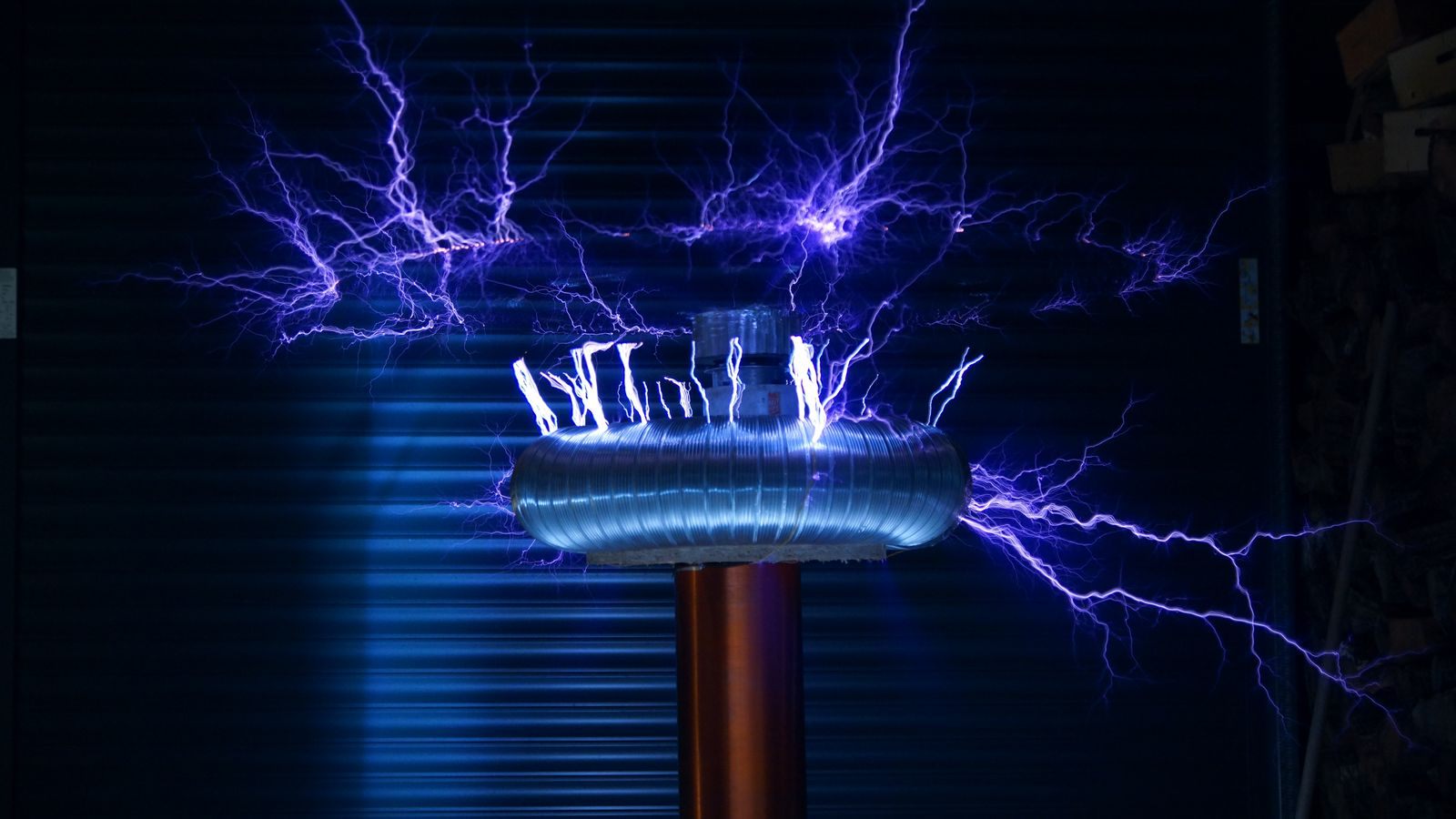
Tesla experimented with wireless power at the turn of the 20th century and dreamed of a worldwide system, but his large-scale plans were never completed. His coil remains a popular demonstration of high-voltage effects.
Are over-the-air chargers safe?
Radio-frequency devices sold in the U.S. must meet FCC exposure limits. That is one reason long-range systems deliver small amounts of power or switch off when a person is in the beam.
For more on radio-frequency exposure rules, see the FCC’s guide to wireless devices and health concerns.
Back to What Works Today
Pads, stands and stations: choosing a short-range wireless charger that fits your space.
Compare Chargers